Basics of spin as applied to table tennis
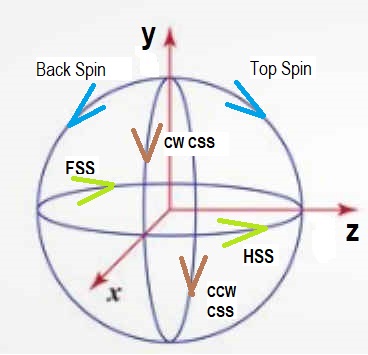
Ball Travels in the +z direction
Horizontal HSS = Hook Side Spin (on the XZ plane)
Horizontal FSS = Fade Side Spin (on the XZ plane)
This is a very simplified presentation of spins. What happens in real world is a bit more complicated because top spin & side spin are usually combined with vertical sidespins and or horizontal sidespins.
This 3 dimensional model identical to an electromagnetic (radio) wave... only applies to spins out of a spinny inverted rubber. In case of long pips (or anti) it becomes n-dimensional model with the ball wobbling about the travel axis and then there is also the Magnus effect.
1. No spin: Happens when the striker hits the ball dead on 90 degrees. Referred to as “slamming” or “smashing”. In modern table tennis, emphasis is maximum spin first, then speed.
2. Top-spin: The bread and butter spin. The striker hits on the top or over the ball. Your racket is moving upwards and forward. For heavy top spin, you should hear very little sound as you are "brushing" the ball.
3. Back-spin: Referred to as the chop. The striker hits under the ball. The racket is moving downwards and forward. You are brushing the ball mostly under it.
4. Horizontal Side-spin: Ball spins from left to right or right to left. You generate this by brushing the back of the ball from left to right with the racket moving vertical.
5. Vertical Side-spin (cork-screw): Ball spins clockwise/counter-clockwise in the Y axis-plane. You generate this by brushing the bottom or top of the ball with the racket moving horizontal.
A loop carries very heavy top-spin. A side-spin-loop also contains a heavy-side-spin component causing the ball to curve sideways in addition to dipping.
A chop is like a slice in tennis but carries much more back-spin. You can distinguish a loop from a chop by the bounce: loops dip down and shoot out; chops tend to shoot up more.